Most home fires do not start with lightning, wiring or a dramatic accident. They start with dinner. According to the National Fire Protection Association (NFPA), cooking is the leading cause of reported home fires and home fire injuries in the United States, and unattended cooking is the leading factor behind them. The good news is that kitchen fires are among the most preventable fires there are. This guide walks DeBary and West Volusia families through the habits that stop cooking fires before they start, exactly what to do in the first few seconds if a pan, oven or microwave catches fire, and how to know when it is time to stop and call 911.
Why the kitchen is where home fires start
The U.S. Fire Administration (USFA) estimates that fire departments responded to about 170,000 home cooking fires in 2021. Those fires caused roughly 135 deaths, 3,000 injuries and more than $494 million in property losses. In non-confined home cooking fires (the kind that spread beyond the pan or oven), unattended equipment was the leading factor in ignition, at 37 percent.
Those numbers make sense when you think about how kitchen fires begin: oil heated past its smoke point, a towel too close to a burner, or a cook who steps away for “just a minute.” None of these situations are unusual, which is why a few consistent habits make such a difference.
Holidays raise the stakes. NFPA has long identified Thanksgiving as the peak day of the year for home cooking fires. NFPA figures cited by the Illinois Office of the State Fire Marshal put the 2023 total at an estimated 1,446 home cooking fires on Thanksgiving Day alone, far above the daily average. In Florida, where the holidays often mean a full house, a warm afternoon and cooking moved outdoors, the same lessons apply on the lanai and in the driveway as in the kitchen.
Rule one: stay in the kitchen
If you remember only one thing from this article, make it this: stand by your pan. The USFA’s advice is simple. If you leave the kitchen, even for a short time, turn the burner off.
Match your attention to the type of cooking
- Frying, grilling and broiling: Stay in the kitchen the entire time. These methods use the highest heat and can go from normal to flames in moments.
- Simmering, baking, roasting and boiling: Check the food regularly, stay in the home while it cooks, and use a timer as a reminder that something is on.
- If you see smoke or the grease starts to boil: Turn the burner off. Smoke is the warning; flames are the next step.
Set up the stove area for safety
- Keep anything that can burn (oven mitts, wooden utensils, food packaging, paper towels, dish towels and curtains) away from the stovetop.
- Turn pot handles toward the back of the stove so no one can bump them or a child cannot grab them.
- Wear short or close-fitting sleeves; loose sleeves can drape over a burner.
- Plug kitchen appliances directly into a wall outlet, not an extension cord, and keep the stove and hood free of built-up grease.
Grease fires: lid on, heat off, never water
A stovetop grease fire is the classic kitchen emergency, and the instinct many people have, grabbing the pan and running it to the sink or throwing a cup of water on it, is exactly the wrong move.
What to do, step by step
- Stay calm and do not move the pan. Carrying a burning pan spills flaming oil onto you, the floor and the cabinets.
- Smother it. Put on an oven mitt and carefully slide a lid or a flat baking sheet over the pan. Cutting off the oxygen puts the fire out.
- Turn off the burner. Removing the heat keeps the oil from reigniting.
- Leave the cover on until the pan is completely cool. Lifting the lid early can let fresh air reach oil that is still hot enough to flare up again.
- If the fire is not out in a few seconds, or it is spreading, get out and call 911 from outside.
Why water makes it worse
Water is heavier than oil, so it sinks straight to the bottom of the pan, where the temperature is far above boiling. It flashes into steam almost instantly, and that expanding steam blasts burning droplets of grease up and out of the pan. Firefighter demonstrations of this produce a fireball that can reach the ceiling. Do not throw flour or other kitchen powders at it either. A lid is the safest, fastest tool you own.
Oven and microwave fires
Oven fires
If food or grease catches fire inside your oven, turn off the heat and keep the door closed. A closed oven is a box with very little oxygen, and the fire will usually burn itself out. Opening the door feeds it fresh air and can send flames toward your face and clothing. Have the oven checked before using it again if anything looks damaged.
Microwave fires
The same principle applies. If something is burning in your microwave, turn it off immediately and keep the door closed until the fire is completely out. Unplug the unit only if you can reach the outlet safely. Common causes include metal (foil, twist ties, dishes with metallic trim), heating food too long, and paper products not meant for the microwave.
Turkey fryers and outdoor frying
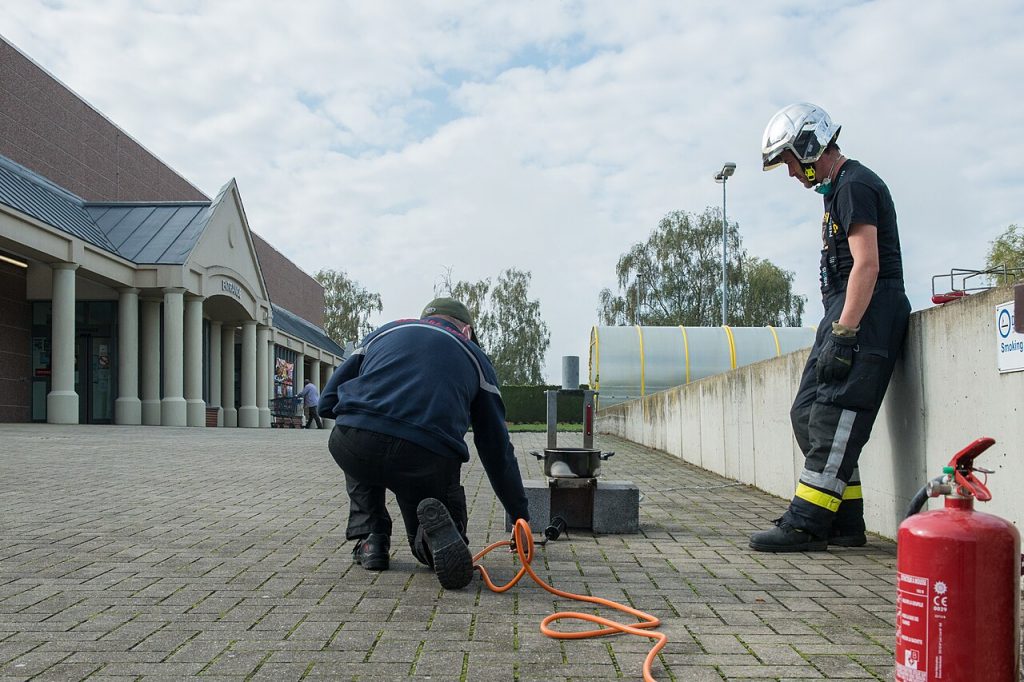
Deep-frying a turkey has become a holiday tradition for many Central Florida families, and our mild November weather makes outdoor cooking tempting. Oil-filled turkey fryers, however, combine gallons of very hot oil, an open propane flame and a heavy, partially frozen bird, a combination that NFPA has long discouraged for home use. If you do fry a turkey, follow the U.S. Consumer Product Safety Commission’s (CPSC) guidelines:
- Keep the fryer in full view the entire time the burner is on.
- Set it up in an open area away from walls, fences and other structures. Never use it in, on or under a garage, breezeway, carport, porch or any structure that can catch fire. In Florida that includes screened lanais and pool enclosures.
- Keep at least 2 feet between the propane tank and the fryer burner, and position them so wind blows the heat away from the tank.
- Thaw the turkey completely (the USDA estimates 24 hours for every 4 to 5 pounds) and pat it dry. Partially frozen or wet turkeys cause dangerous splattering.
- Do not overfill the pot. If the manufacturer’s instructions do not give an oil amount, place the turkey in the pot, cover it with water, remove the turkey, and mark the water line. Dry the pot thoroughly and fill with oil only to that line.
- Raise and lower the turkey slowly, cover bare skin, and check the oil temperature often.
- If the oil begins to smoke, turn the gas supply off immediately.
- If a fire starts, call 911. Do not try to put it out with water.
Keep children and pets well away, and remember the oil stays dangerously hot for hours afterward.
Kids, pets and the 3-foot kid-free zone
Children are naturally curious about the stove, and scald burns from hot liquids and spilled food are a real danger even when nothing catches fire. NFPA recommends a kid-free zone of at least 3 feet around the stove and anywhere hot food or drinks are prepared or carried.
- Mark the zone with tape on the floor so younger children can see the line.
- Use the back burners when possible, and keep hot drinks away from table and counter edges.
- Never hold a child while cooking or carrying something hot.
- Give older children kitchen jobs away from the heat, and keep pets out of the cooking area.
Fire extinguishers: the right type and the PASS method
A portable extinguisher can put out a small fire or hold it in check until firefighters arrive, but only if it is the right type, you can reach it, and you know how to use it.
Understanding extinguisher classes
| Class | What it is for | Kitchen notes |
|---|---|---|
| A | Ordinary combustibles: paper, wood, cloth, many plastics | Dish towels, cardboard packaging, a trash can fire |
| B | Flammable and combustible liquids: gasoline, oils, kerosene | Small amounts of burning grease or oil |
| C | Energized electrical equipment: wiring, motors, appliances | A toaster, mixer or microwave that is still plugged in |
| D | Combustible metals such as magnesium and aluminum | Not a household kitchen concern |
| K | Vegetable or animal oils and fats in cooking appliances | Designed for the large oil volumes in commercial deep fryers |
For most homes, a multipurpose extinguisher labeled A-B-C is the practical choice. Mount it near an exit from the kitchen rather than directly beside the stove, so you can grab it while moving away from the fire and keep your escape route behind you. Check the gauge monthly and follow the manufacturer’s instructions for service or replacement. When using any extinguisher on a pan of oil, start from the distance shown on the label; discharging too close can push burning grease out of the pan. For a stovetop pan fire, a lid is still your first and best option.
PASS: four steps to remember
- Pull the pin. This also breaks the tamper seal.
- Aim low, pointing the nozzle at the base of the fire, not the flames.
- Squeeze the handle slowly and evenly to release the agent.
- Sweep from side to side at the base of the fire until it appears to be out. Watch it afterward, because fires can reignite.
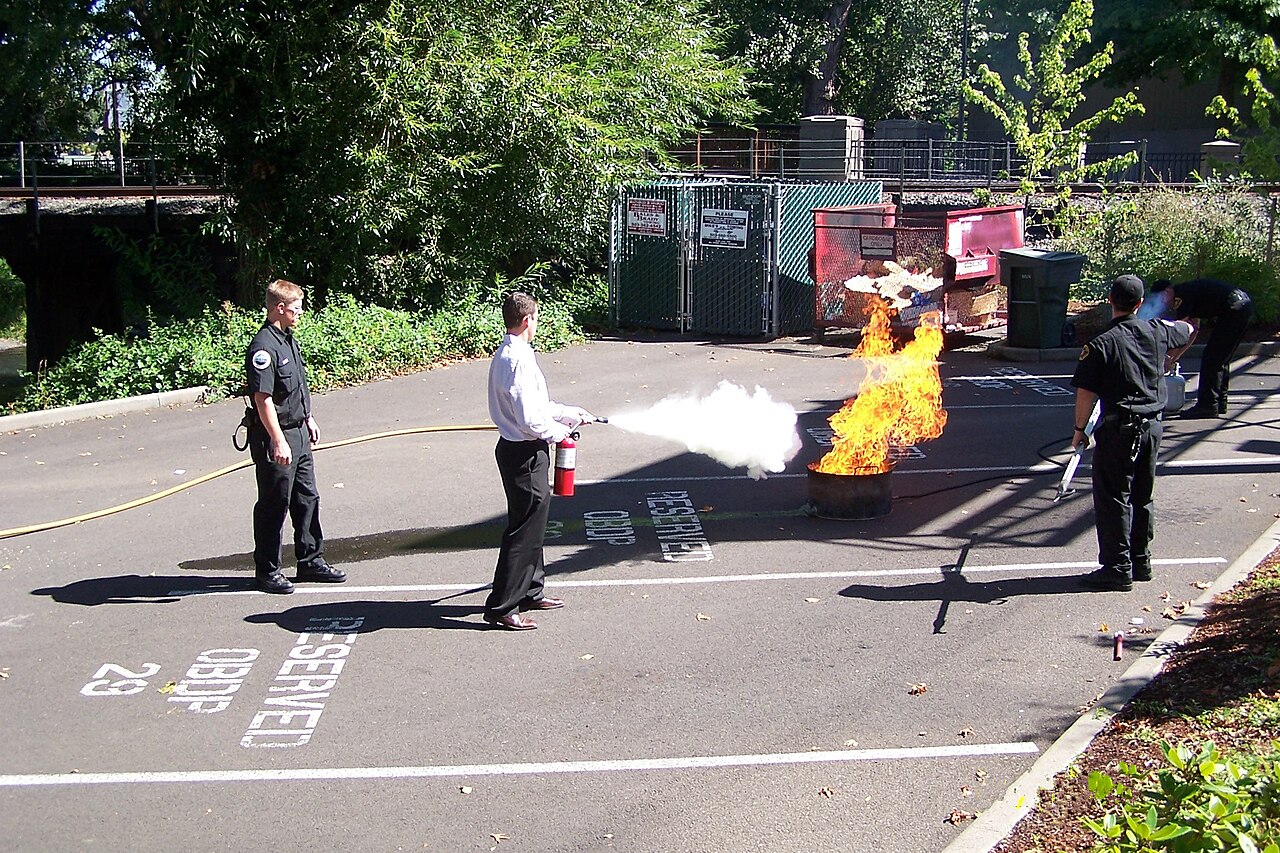
Practice the motions before you ever need them; hands-on extinguisher demonstrations at community fire safety events are a great way to get comfortable.
When to get out and call 911
Fire grows fast. FEMA’s Community Emergency Response Team training teaches a simple decision test before anyone picks up an extinguisher. Only fight a fire if all of these are true:
- Everyone else is leaving or has left the home, and 911 has been called or is being called.
- The fire is small, contained (like a single pan or wastebasket) and not growing.
- The room is not filling with smoke.
- You have a clear exit behind you.
- Your extinguisher is the right type and size for the fire.
If any answer is no, or you cannot knock the fire down within about five seconds, stop. When in doubt, get out. Leave the home, close doors behind you to slow the fire’s spread, and call 911 from outside. Never go back inside for belongings or pets; tell arriving firefighters who or what may still be inside.
Two other tools work alongside your extinguisher. Working smoke alarms give you the early warning that makes escape possible (the USFA suggests keeping alarms about 10 feet from the stove to cut down on nuisance alarms; see our guide to smoke alarm placement, testing and replacement). And a practiced escape plan means everyone knows two ways out of every room; our home fire escape plan guide shows you how to make one in an evening.
Your kitchen fire safety checklist
- I stay in the kitchen when frying, grilling or broiling, and turn the burner off if I step away.
- A lid or baking sheet is within reach whenever I cook with oil, and everyone knows: never water on grease.
- Oven or microwave fire: heat off, door closed.
- We keep a 3-foot kid-free zone around the stove.
- An A-B-C extinguisher is mounted near the kitchen exit, and adults know PASS.
- Smoke alarms are tested monthly, and our family has practiced our escape plan.
For a printable, whole-home version, use our fire safety checklist.
Frequently asked questions
Can I put out a grease fire with water?
No. Water sinks under the burning oil, flashes to steam and throws flaming grease across the kitchen. Slide a lid or baking sheet over the pan, turn off the burner and leave the cover on until the pan is completely cool.
What should I do if my oven catches fire?
Turn off the heat and keep the oven door closed so the fire runs out of oxygen. If the fire does not go out quickly, or smoke spreads, leave the home, close the door behind you and call 911 from outside.
What kind of fire extinguisher should I keep in my kitchen?
Most homes are well served by a multipurpose extinguisher rated for Class A, B and C fires, mounted near an exit rather than right next to the stove. Class K extinguishers are designed for the large volumes of cooking oil found in commercial deep fryers.
How far should children stay from the stove?
Fire safety educators recommend a kid-free zone of at least 3 feet around the stove and anywhere hot food or drinks are being prepared or carried.
When should I stop trying to fight a kitchen fire?
Get out if the fire is spreading, the room is filling with smoke, you do not have a clear path to an exit, or you cannot knock it down within a few seconds. Close the door behind you and call 911 from outside.
Sources and further reading
- NFPA: Cooking safety
- U.S. Fire Administration: Cooking fire safety
- CPSC: Safety tips for turkey fryers
- Illinois Office of the State Fire Marshal: Thanksgiving cooking safety (citing NFPA data)
- FEMA IS-909 Community Preparedness: Putting out fires (extinguisher classes and PASS)
- Fairfax County Fire and Rescue: Fire extinguisher guidance
Want to help DeBary’s firefighters spread the word about kitchen fire safety? Volunteer with the DeBary Volunteer Fire Support Team and join us at community events, or support our work keeping firefighters hydrated and equipped. Contributions are not deductible as charitable contributions for federal income tax purposes.